Enhance the user experience for your website visitors
Improve the build of your website to WCAG 2.2 Compliance
Instantly find and remediate every inaccessible PDF on your website
Accelerate your compliance journey with manual auditing and remediation
Get a free automated scan of your homepage for WCAG compliance issues and provides recommended fixes
Your hub for accessibility learning, resources, and support
Latest accessibility updates, insights, and industry trends
Practical, step-by-step resources to improve accessibility
Structured training to build accessibility skills and confidence
Get a free automated scan of your homepage for WCAG compliance issues and provides recommended fixes
A COMIC ABOUT DIGITAL ACCESSIBILITY
BY PAUL MILLER × RECITE ME
What happens when the housing advice you need is online, but you can’t make sense of what to do next? Follow Carys, a Deaf designer, as she tries to find help after learning she has to leave her flat.
Illustrations by Paul Miller, Rory Studio CIC
Recite Me worked with Deaf artist Paul Miller to tell a story about what digital accessibility means in everyday life, and what can happen when websites fall short. Inspired by our research into the accessibility of UK local authority websites, the comic follows Carys as she looks for housing advice and tries to work out when she can ask for help.
When the guidance is hard to understand, Carys loses time and has to share private information just to find out what her options are. The comic also shows how clear information could let her take the next step independently.
THE COMIC
Carys is 32. She designs children’s clothes, makes hearing aid charms celebrating Deaf identity and shares her flat with her ginger cat, Wobbles. When a letter from her landlord arrives, she goes online to find out what to do next.
Illustrations by Paul Miller, Rory Studio CIC.
PAGE 1 OF 5
PAGE 2 OF 5
PAGE 3 OF 5
PAGE 4 OF 5
PAGE 5 OF 5
This is a text version of all five comic pages. It describes each panel in order and includes every caption and line of dialogue.
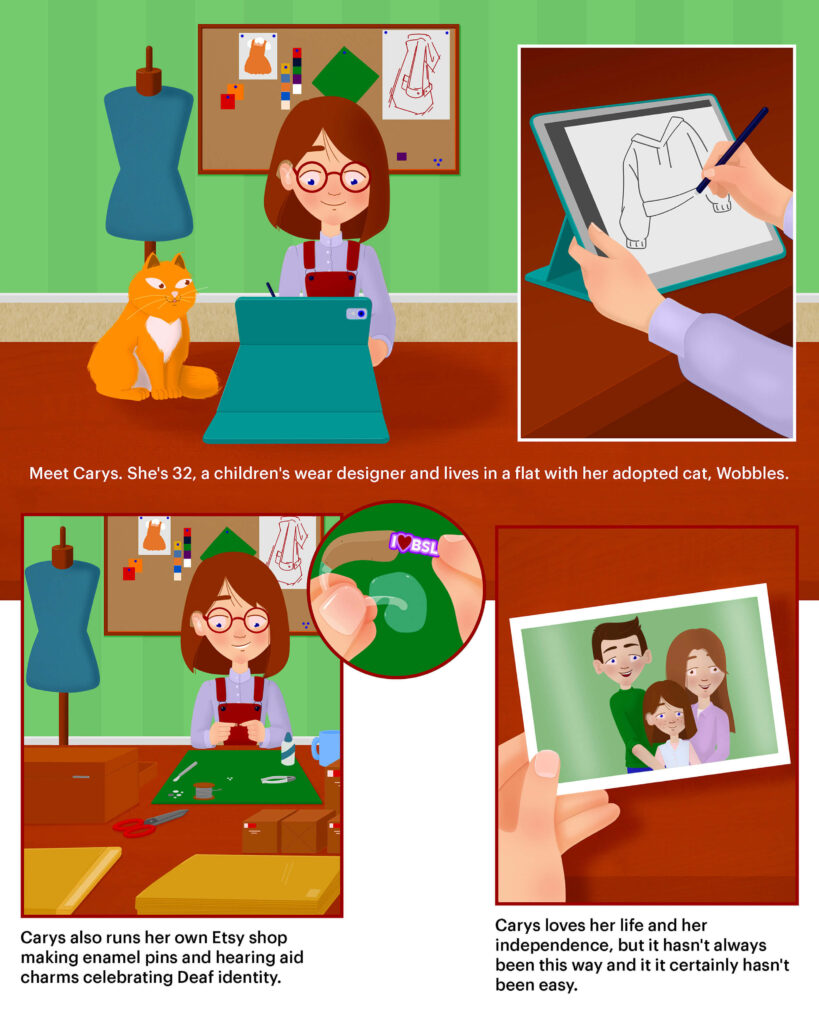
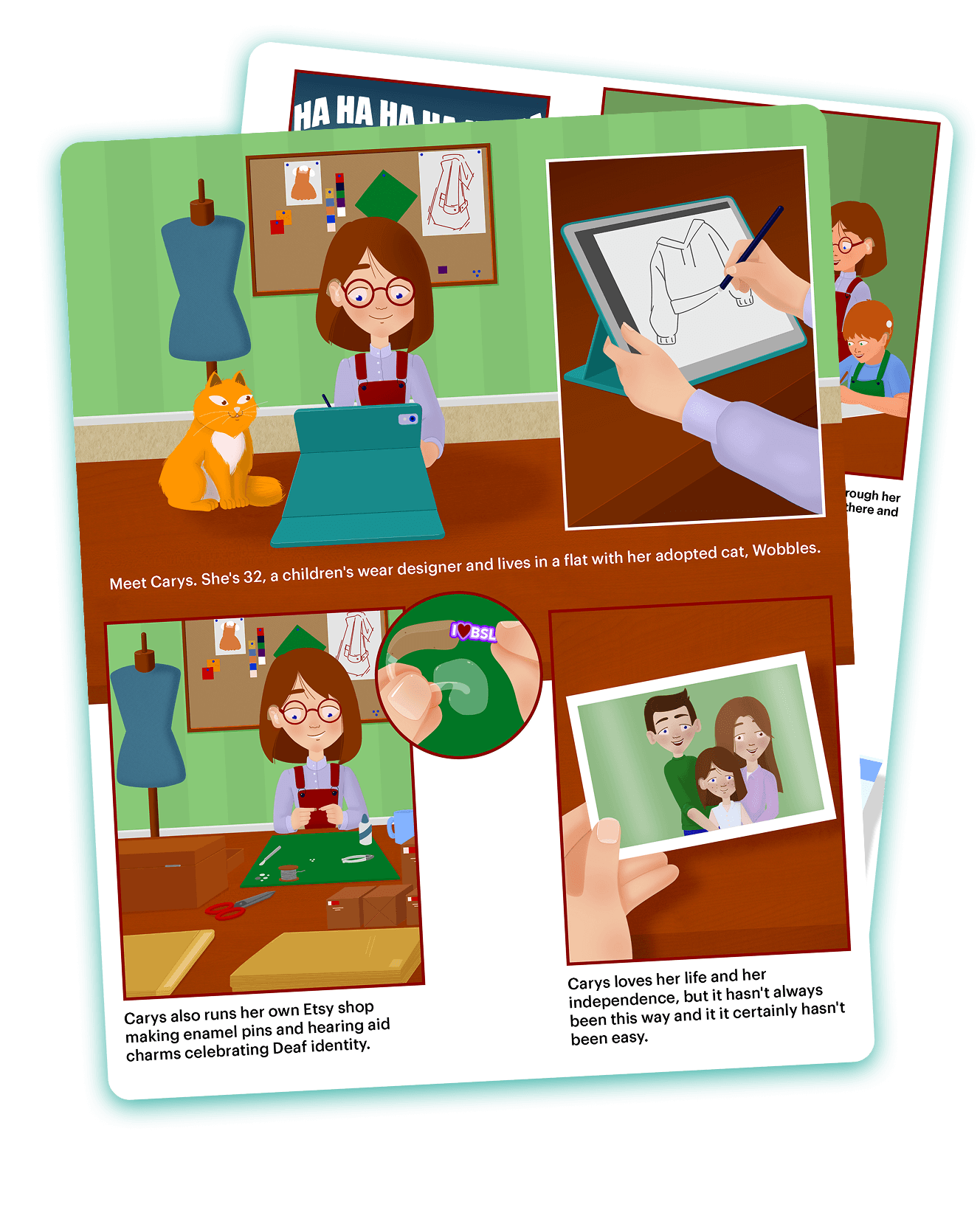
Scene: Carys, who has a brown bob, red glasses and a hearing aid, sits at her desk drawing a hoodie design on a tablet. Her ginger cat, Wobbles, sits beside her and a dressmaking mannequin stands behind her.
Caption: Meet Carys. She’s 32, a children’s wear designer and lives in a flat with her adopted cat, Wobbles.
Scene: Carys makes jewellery at her desk, surrounded by parcels. A close-up shows a hearing aid charm that reads “I love BSL”.
Caption: Carys also runs her own Etsy shop making enamel pins and hearing aid charms celebrating Deaf identity.
Scene: Carys holds a family photograph from her childhood.
Caption: Carys loves her life and her independence, but it hasn’t always been this way and it certainly hasn’t been easy.
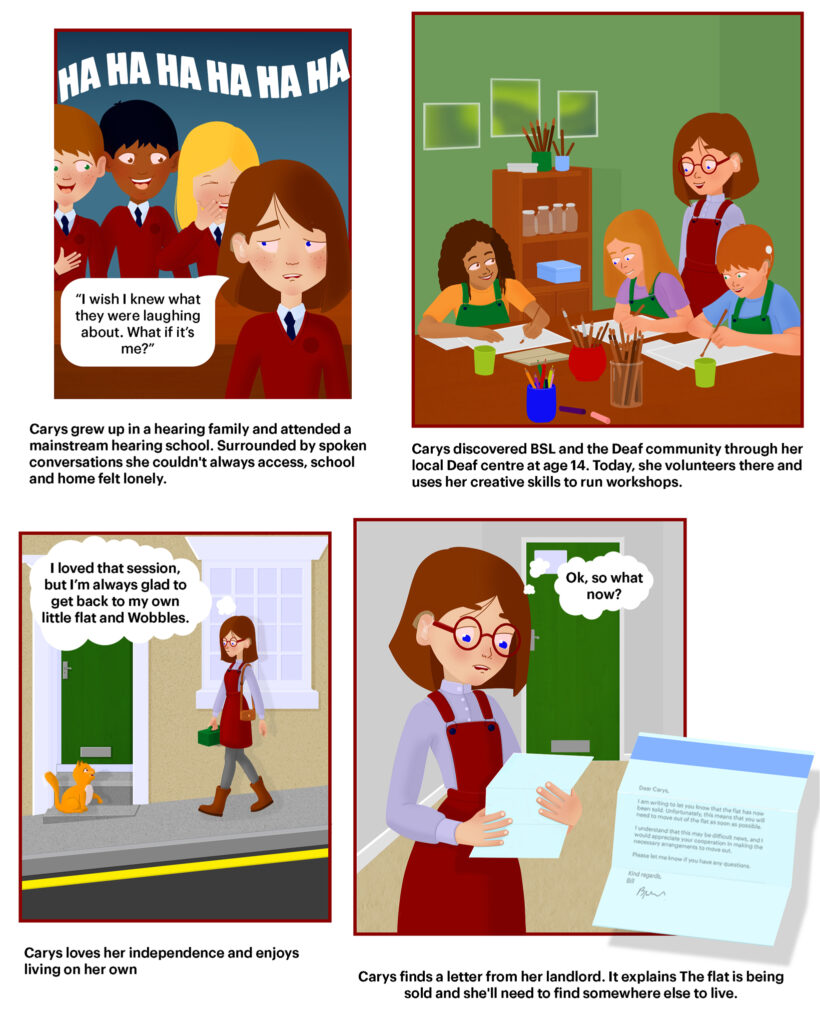
Scene: As a schoolgirl, Carys looks isolated while classmates laugh behind her.
Carys thinks: “I wish I knew what they were laughing about. What if it’s me?”
Caption: Carys grew up in a hearing family and attended a mainstream hearing school. Surrounded by spoken conversations she couldn’t always access, school and home felt lonely.
Scene: Adult Carys helps children at an art workshop.
Caption: Carys discovered BSL and the Deaf community through her local Deaf centre at age 14. Today, she volunteers there and uses her creative skills to run workshops.
Scene: Carys walks home. Wobbles waits on the doorstep.
Carys thinks: “I loved that session, but I’m always glad to get back to my own little flat and Wobbles.”
Caption: Carys loves her independence and enjoys living on her own.
Scene: Carys looks worried as she reads a letter.
Letter: Dear Carys, I am writing to let you know that the flat has now been sold. Unfortunately, this means that you will need to move out of the flat as soon as possible. I understand that this may be difficult news, and I would appreciate your cooperation in making the necessary arrangements to move out. Please let me know if you have any questions. Kind regards, Bill
Carys thinks: “Ok, so what now?”
Caption: Carys finds a letter from her landlord. It explains the flat is being sold and she’ll need to find somewhere else to live.
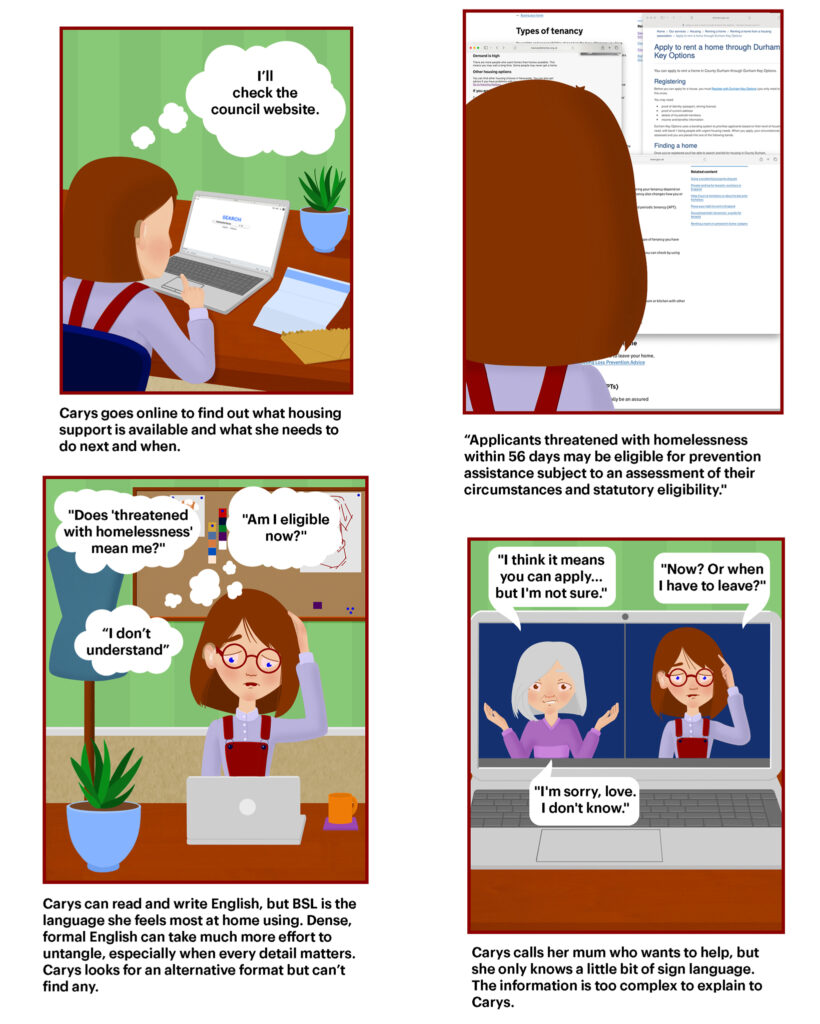
Scene: Carys sits at her laptop with the letter beside her.
Carys thinks: “I’ll check the council website.”
Caption: Carys goes online to find out what housing support is available and what she needs to do next and when.
Scene: Several dense council webpages overlap on her screen.
Webpage text: “Applicants threatened with homelessness within 56 days may be eligible for prevention assistance subject to an assessment of their circumstances and statutory eligibility.”
Scene: Carys holds her head, looking distressed.
Carys thinks: “Does ‘threatened with homelessness’ mean me?” “Am I eligible now?” “I don’t understand.”
Caption: Carys can read and write English, but BSL is the language she feels most at home using. Dense, formal English can take much more effort to untangle, especially when every detail matters. Carys looks for an alternative format but can’t find any.
Scene: Carys is on a video call with her mum.
Mum: “I think it means you can apply… but I’m not sure.”
Carys: “Now? Or when I have to leave?”
Mum: “I’m sorry, love. I don’t know.”
Caption: Carys calls her mum who wants to help, but she only knows a little bit of sign language. The information is too complex to explain to Carys.
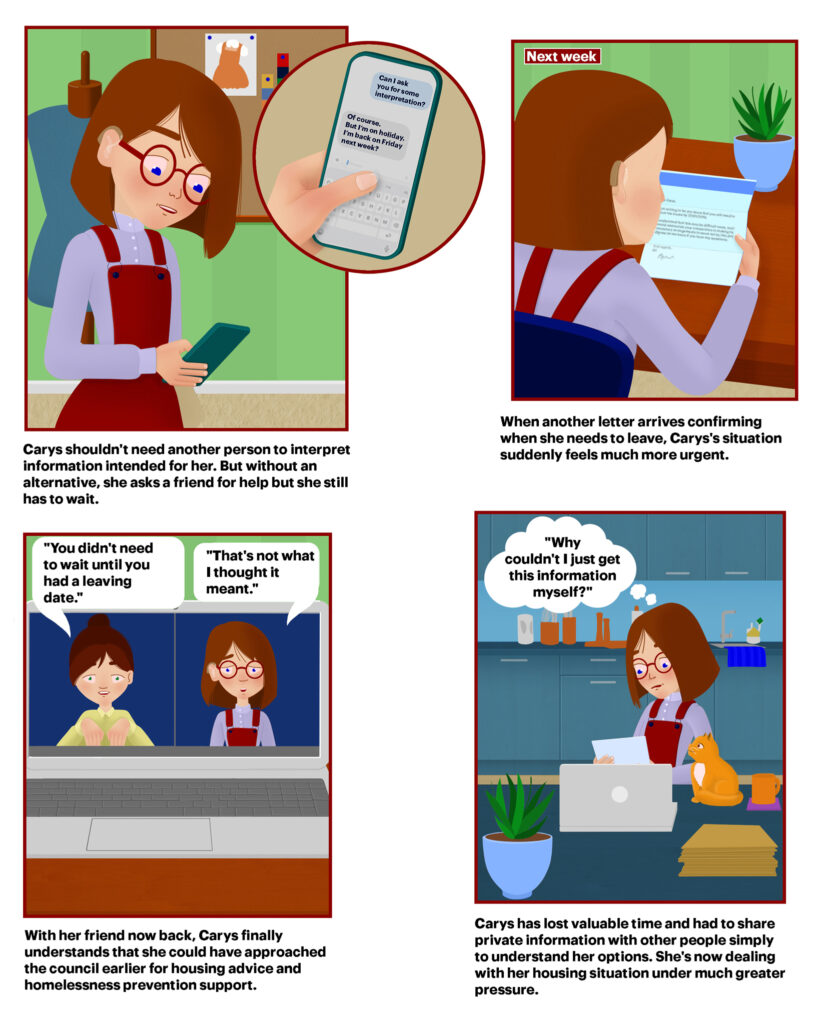
Scene: Carys messages a friend on her phone.
Carys: “Can I ask you for some interpretation?”
Friend: “Of course. But I’m on holiday. I’m back on Friday next week?”
Caption: Carys shouldn’t need another person to interpret information intended for her. But without an alternative, she asks a friend for help but she still has to wait.
Scene: Next week. Carys reads another letter from her landlord.
Caption: When another letter arrives confirming when she needs to leave, Carys’s situation suddenly feels much more urgent.
Scene: Carys is on a video call with her friend.
Friend: “You didn’t need to wait until you had a leaving date.”
Carys: “That’s not what I thought it meant.”
Caption: With her friend now back, Carys finally understands that she could have approached the council earlier for housing advice and homelessness prevention support.
Scene: Carys sits in her kitchen with her laptop, letters and Wobbles.
Carys thinks: “Why couldn’t I just get this information myself?”
Caption: Carys has lost valuable time and had to share private information with other people simply to understand her options. She’s now dealing with her housing situation under much greater pressure.
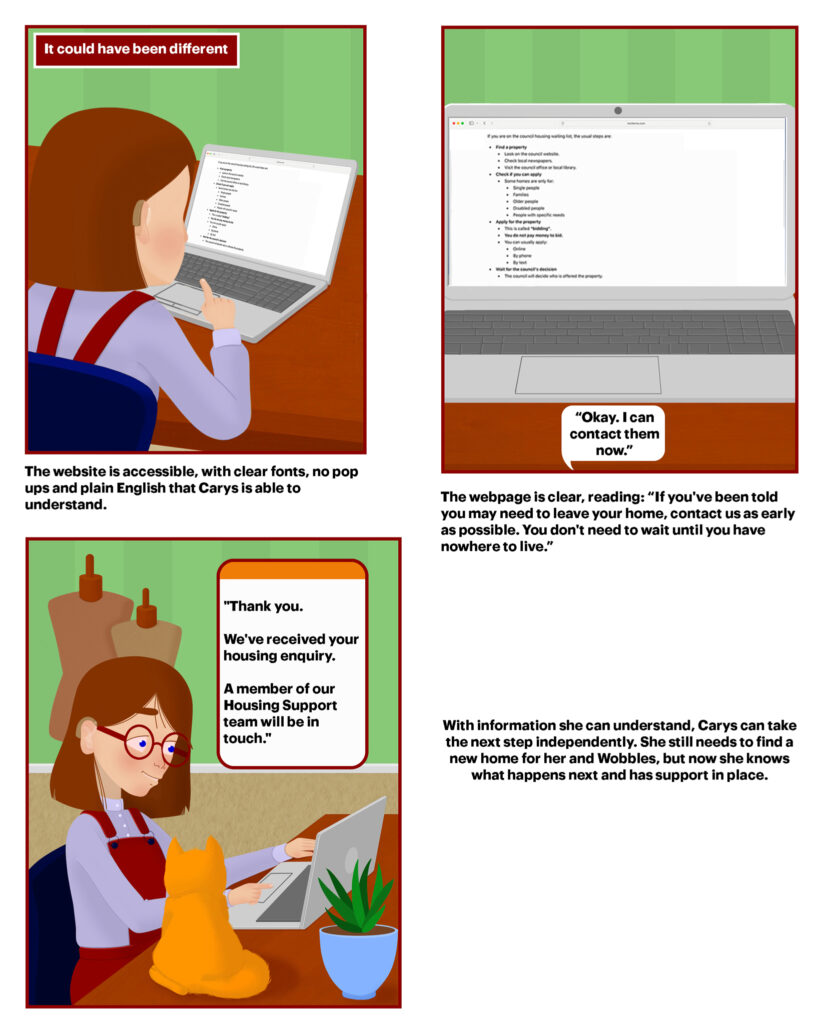
Scene: Carys uses a council website on her laptop.
Caption: The website is accessible, with clear fonts, no pop ups and plain English that Carys is able to understand.
Webpage text: “If you’ve been told you may need to leave your home, contact us as early as possible. You don’t need to wait until you have nowhere to live.”
Carys: “Okay. I can contact them now.”
Scene: Carys smiles as she submits a housing enquiry, with Wobbles beside her.
Confirmation message: “Thank you. We’ve received your housing enquiry. A member of our Housing Support team will be in touch.”
Caption: With information she can understand, Carys can take the next step independently. She still needs to find a new home for her and Wobbles, but now she knows what happens next and has support in place.
THE ARTIST
Paul Miller is an award-winning Deaf artist, animator, writer and theatre director. A British Sign Language (BSL) user, Paul is the founder and artistic director of Rory Studio CIC, a Deaf-led arts organisation based at Dance City in Newcastle upon Tyne. His work brings Deaf experiences and culture to wider audiences through illustration, animation and live theatre.
IN HIS OWN WORDS
Here, Paul Miller talks about his work, why he wanted to work with Recite Me and what he hopes councils will take away from the work when it comes to building accessible digital services.
So, I'm a freelance artist based in the northeast. I'm director of Rory Studio CIC. I write and illustrate children's books.
I also create short film animations. I'm also a theatre director. The aim of Rory Studio is mostly at children and families and a lot of the work we do, for example, is if we put on a show, we make it accessible for deaf and hearing audiences.
The aim is not to have the interpreter on the stage. We want to have sign language and English language immersed together on the stage so everybody can enjoy it at the same time. When I was younger, I would always read comics and storybooks.
I mean, at that time, I couldn't read and comic books are very visual. So, I was always really engaged in that and I loved the illustrations in comic books. That sort of really inspired me to create my own artwork.
I used to do artwork every single day and I still do it even till now. My entire life, I do art every single day and it just kind of became a bit frustrating for me that there was no deaf person identifiable in the books that I was reading and I just thought, well, maybe now is the time that I roll up my sleeves and perhaps create stories that have a main deaf character within them and I felt the same within the theatre. I have main deaf characters in the theatre productions that we do and we make sure that the sign language is accessible for the deaf audience but that we also have a voiceover for the hearing audience members.
We also incorporate subtitles so it means that the entire production is inclusive. It's just open for everybody and it's there for children to really enjoy in whatever way that they can enjoy that. I thought it would be a great fit into the types of things that I do.
I've been, what you were telling me, I've been through similar experiences myself and through government websites and various other websites, information can be really difficult for me to access and I know I'm not the only one. I know there are lots of people even in the northeast alone that are going to have problems accessing that information so I felt that the project really suited me because I'm an illustrator and, you know, I love comics and I just think that that combination really worked well. I was able to express my own feelings in those situations and put those into the illustrations because I have those experiences so I could incorporate that into the illustrations.
So a lot of websites have barriers and that's always been my experience and it is bad really and I've had a lot of bad experiences and at that time when I was living with my mum, we were living in a council house and she very suddenly died and after that I would try to find information online that I couldn't access and my partner at the time tried to help, helped me get through the website but even herself was finding it hard to find what and she was struggling with the website too and a lot of the time it would say you need to phone this person and you need to phone this and there was no email access so I thought well how? I got on phone. I mean luckily my partner said okay I'll phone for you but a lot of the time she would try and call and nobody would answer and in the end we decided it would be best to just go to the council ourselves and explain our situation but the way a lot of the information came to us at the time was well you just need to be out of the house. They asked me if I wanted to stay or if I wanted to leave but I said I wanted to stay so it was a really good job in the end that I did turn up at the council and say to them this is my situation, how can you help me? Because some deaf people might not have a hearing partner to help in that situation, they might be on their own and how would they have got through that same situation if they reached barriers on the website that couldn't get them the help that they needed and it's not only the council you know we're talking about water bills and how do I contact them? It's phone only like okay I'm deaf but how do you expect me to do that? If I'm banking and it's all online that all becomes a problem as well any problems you have to phone so it's becoming a lot harder now for deaf people to access anything online it's getting worse more and more barriers are being put in place now that access is completely different to what it used to be.
For me I hope that my illustrations will impact them and they can see the deaf character through the story see how they hit these barriers online and how that came about for it to help them when they go through the story and I hope that helps them to be more mindful when they put things together in the future be mindful of disabilities deafness people who can't read well try and think about all those other minority groups and try and just think how you can best meet those audiences
OUR RESEARCH
People rely on council websites to find housing advice, check their council tax and access other essential services. Our research into UK local authority websites looks at the digital barriers people can encounter when trying to find information or use those services online.