

Free ADA Compliance Audit of your Website
Run a free scan of your website's homepage to identify any ADA violations. Then, use our recommendations to implement fixes and achieve ADA compliance.
The Americans with Disabilities Act (ADA) mandates, among other things, that websites must accommodate users with disabilities. Failing to meet these business requirements can result in hefty legal penalties, reputational damage, and lost growth opportunities. In fact, complying with the ADA holds particular weight in Florida, where nearly 21% of the population are aged 65 or older – a demographic known for its high rates of disability and dependence on accessible digital features.
Curious to know whether the ADA applies to you and what you can do to stay compliant? This guide has everything you need to know.
Understanding the role of the Americans with Disabilities Act in Florida
The ADA is a federal civil rights law that prohibits disability-based discrimination. It is organized into five titles that define obligations for different organization types:
- Title I – Employment: Employers with 15 or more employees must provide reasonable accommodations.
- Title II – Public Services: State and local governments must ensure services and programs are accessible.
- Title III – Public Accommodations: Private businesses must ensure access to services, including websites.
- Title IV – Telecommunications: Requires accessible communications for individuals with hearing or speech impairments.
- Title V – Miscellaneous: Clarifies legal relationships and protections.
Together, these five titles form the legal framework behind ADA compliance in Florida, shaping how organizations design workplaces, deliver services, and build accessible digital experiences for all users.

Which organizations do the Florida ADA guidelines apply to?
The ADA applies broadly, covering the vast majority of organizations operating in Florida:
- Public Accommodations: Any business open to the public, including restaurants, hotels, retail stores, theaters, and healthcare providers.
- Employers: Organizations with more than 15 employees must ensure digital tools and job applications are accessible.
- State and Local Governments: Must comply regardless of size, ensuring all residents can access information and participate fully in civic life.
There are very few exceptions to ADA compliance in Florida. Limited exemptions exist for private clubs and certain religious entities, but the scope is narrow and rarely applies to public-facing organizations. Even where exemptions are valid, prioritizing accessibility remains a smart business decision to reduce complaints, negative publicity, and legal risk.
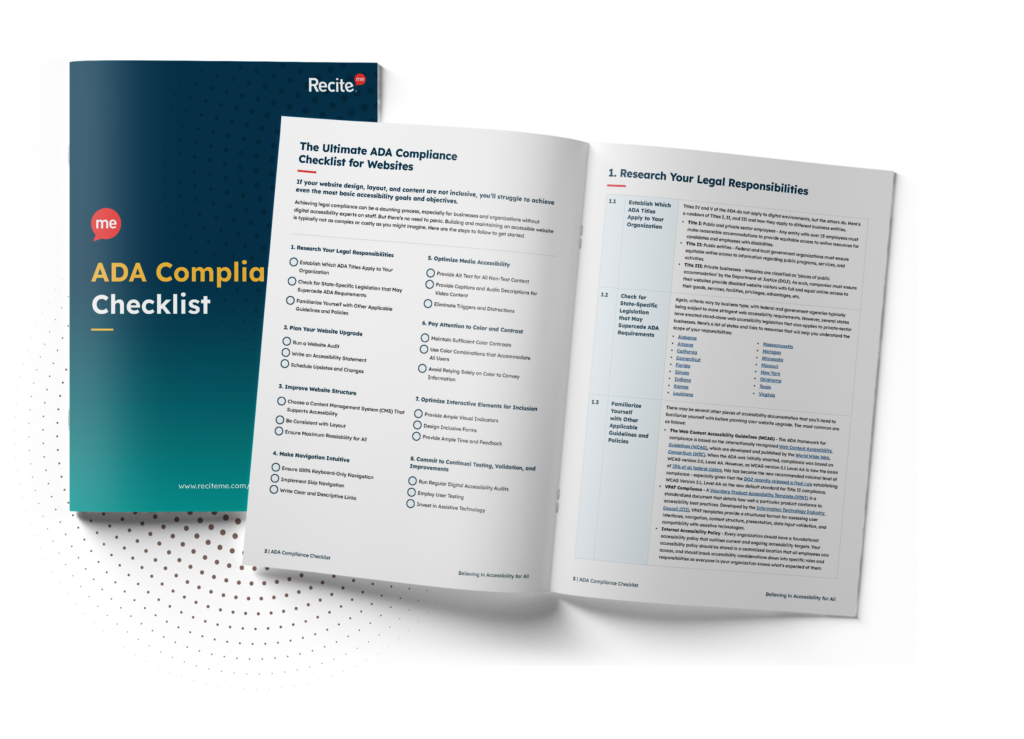
Want to make sure your website is compliant with the Americans with Disabilities Act? Then unlock the ADA compliance checklist now. Discover actionable steps to ensure ADA compliance, helping you avoid lawsuits and any other negative consequences of non-compliance.
Tips to making your website ADA compliant in Florida
ADA accessibility lawsuits continue to rise nationwide, increasing by approximately 37% year on year. Florida consistently ranks among the top three states for digital accessibility lawsuits, making ADA compliance a pressing priority for public and private entities alike.
For most organizations, achieving compliance revolves around proactive testing, regular updates, and alignment with globally recognized accessibility standards.
Continuous accessibility testing
Website accessibility testing typically follows a layered approach designed to identify both technical errors and real-world usability barriers.
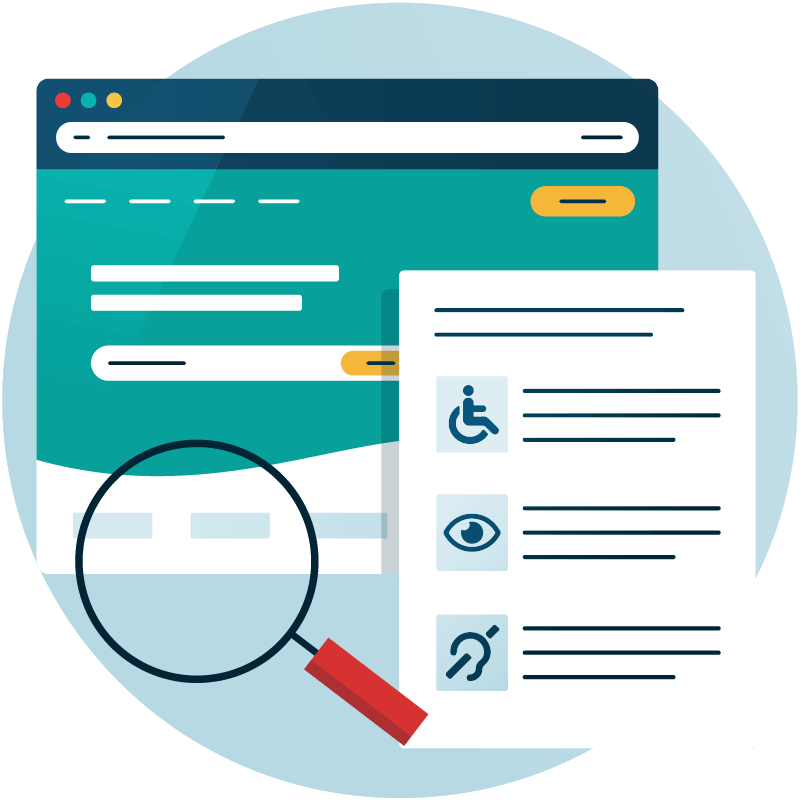
A proper strategy for ADA compliance in Florida includes:
- Automated accessibility testing to detect common issues such as missing alt text, insufficient color contrast, broken ARIA attributes, and structural errors.
- Manual expert reviews to evaluate keyboard navigation, focus order, form usability, modal behavior, and dynamic content updates.
- Real-user testing with assistive technologies like screen readers, magnification software, and voice navigation tools to uncover practical barriers that automation alone cannot detect.
Essentially, testing should not be treated as a one-time exercise but conducted regularly, particularly after website redesigns, feature launches, or significant content updates.
Meet minimum WCAG standards
The Web Content Accessibility Guidelines (WCAG) are widely accepted as the global benchmark for digital accessibility. They are built around four core POUR principles, meaning digital content must be Perceivable, Operable, Understandable, and Robust.
WCAG accessibility criteria are structured across three levels, ranging from A (basic accessibility requirements) through AA (the most common and impactful barriers) to AAA (the highest and most complex level of accessibility conformance). These standards provide practical guidance across a range of website elements, including:
While ADA compliance in Florida does not explicitly mandate a specific WCAG version or level, meeting WCAG 2.1 Level AA is widely regarded as the minimum standard necessary to reduce legal exposure. However, as accessibility expectations continue to evolve, organizations are increasingly aligning with WCAG 2.2 Level AA to future-proof their digital presence and demonstrate a stronger commitment to inclusive design.
Risks of not complying with Florida ADA standards
Failing to prioritize ADA compliance in Florida carries tangible legal and commercial consequences. The three primary risks are as follows.
Legal Penalties
Non-compliance with ADA standards can result in hefty fines, with penalties ranging between $75,000 and $150,000, depending on whether it’s a first offense or a repeat violation. The cost of legal fees and settlements can strain your financial resources even further, dealing a big setback to your bottom line.
Reputational Damage
We live in a world where consumers are increasingly making ethical purchasing decisions. This highlights a trend in which the general public are vastly in favor of diverse, inclusive, and accessible environments. Should you face any ADA-related lawsuits, and this becomes public knowledge, you risk tarnishing your brand’s reputation for years.
Social media and online reviews can also have a lasting impact on public perception. This is important because even if a lawsuit filed against you is deemed unsuccessful, there is a chance that a stain will remain on your reputation. Remove all risk by complying with the ADA in its entirety and implementing accessibility best practices company-wide.
Loss of Business Opportunities
Failing to comply with the ADA represents a lost opportunity for growth. The disabled community is a significant and often under-served market segment. By not making your website accessible, you are excluding a large potential customer base, missing out on the chance to expand your reach.
Previous ADA lawsuits that have been brought to Florida courts
Florida has seen several high-profile ADA lawsuits, which highlight the importance of compliance. Let’s take a closer look at some of the main cases:
Haynes v Hooters
Haynes v Hooters is a fairly well-known ADA lawsuit in Florida, where the plaintiff alleged that Hooters’ website failed to meet accessibility standards for visually impaired users. A prior settlement required remediation, yet further legal action followed when compliance was deemed insufficient. This case underscores the importance of continuous monitoring rather than one-time fixes.
Gil v Winn-Dixie
In the case of Gil v Winn-Dixie, the court ruled that the grocery chain’s website must be accessible to screen reader users because it was closely integrated with its physical stores. The decision reinforced that websites connected to public-facing businesses fall under Title III obligations. Although later appeals introduced nuance, the case signaled a clear judicial willingness to scrutinize inaccessible websites.
Circle K
While not website-specific, this Florida case involved failure to accommodate employees with disabilities and resulted in Circle K agreeing to pay $8 million. It underscores the importance of Title I ADA compliance in Florida, particularly regarding inclusive employment practices and appropriate workplace accommodations.
Free ADA Compliance Audit of your Website
Run a free scan of your website's homepage to identify any ADA violations. Then, use our recommendations to implement fixes and achieve ADA compliance.
Protect your business by ensuring ADA compliance
There’s more to ensuring accessibility than avoiding lawsuits and penalties. It’s also about inclusion, resilience, and long-term growth. However, with rising lawsuit volumes and increased judicial focus on digital platforms, it has never been more important for businesses, public entities, and employers to take proactive steps to reduce legal exposure and improve usability.
Download your free ADA compliance scan today to see where your website stands, and speak with our team about building a clear remediation roadmap that helps future-proof your digital presence.
ADA compliance in Florida FAQs
Looking for a recap or quick summary? Here are a few of our most frequently asked questions to help you get to grips with the essentials:
Is it illegal to have an inaccessible website in Florida?
In many cases, yes. Courts have consistently interpreted Title III to apply to websites connected to public-facing businesses. If your website prevents individuals with disabilities from accessing essential services, information, or transactions, it may be considered discriminatory under federal law.
Are small businesses exempt from ADA compliance in CA?
No. Under Title I, certain exemptions apply to organizations with fewer than 15 employees. However, public-facing businesses of all sizes are subject to Title III obligations. This includes startups and small online enterprises.
Can I be sued in Florida if my website isn't accessible?
Yes. If a user encounters barriers to equal access, legal action may be possible. Individuals, advocacy groups, and so-called “tester” plaintiffs have filed hundreds of website accessibility lawsuits in Florida, which ranks among the most active jurisdictions for ADA-related claims.
Can I make my existing website ADA-compliant?
Yes. A phased approach aligned with WCAG standards can significantly improve compliance without rebuilding your entire website. Many accessibility barriers can be addressed through structured audits, targeted remediation, code adjustments, content updates, and improved design practices.
Do third-party tools affect ADA compliance?
Yes. Organizations are responsible for the accessibility of third-party tools integrated into their websites. This includes payment processors, booking systems, chat widgets, scheduling software, and other embedded services.
Need more help becoming ADA compliant?
The following resources are packed full of actionable tips and expert advice for making your digital content compliant with the Americans with Disabilities Act:
Free ADA Accessibility Training
Take the first step to ADA compliance by completing our training course.
Free ADA Accessibility Guide
Ensure your organization is meeting the requirements for ADA compliance.