

Free ADA Compliance Audit of your Website
Run a free scan of your website's homepage to identify any ADA violations. Then, use our recommendations to implement fixes and achieve ADA compliance.
The ADA requires businesses and public entities to provide equal access to people with disabilities, including across digital experiences. With nearly 1 in 4 Americans living with a disability, digital accessibility gaps can quickly lead to poor user experiences, reputational damage, and costly legal disputes.
ADA compliance in California is often viewed as a higher-risk area from a litigation perspective due to the interaction between federal ADA claims and California’s Unruh Civil Rights Act, which allows for statutory damages in addition to federal remedies.
In this guide, we explain what ADA compliance in California means, the standards most organizations follow, and the practical steps you can take to improve usability while reducing legal and financial risk.
Understanding the Americans with Disabilities Act in California
The Americans with Disabilities Act (ADA) is a federal accessibility law that prohibits disability discrimination. Although it was enacted before the modern internet era, courts and regulators have consistently interpreted digital platforms as extensions of “places of public accommodation,” particularly when websites or apps are directly tied to goods or services offered to the public.
In practice, ADA compliance in California often comes down to three key factors:
- Whether your organization falls under Title I, Title II, or Title III.
- Whether your website or app aligns with widely recognized accessibility standards, typically the Web Content Accessibility Guidelines (WCAG).
- Whether California’s civil rights framework increases legal exposure beyond federal ADA requirements.

Understanding how these elements interact is essential. ADA compliance in California is not just about technical website fixes. It’s about aligning your digital operations with both federal obligations and California’s heightened enforcement environment.
Which California businesses does the ADA apply to?
In California, most businesses and public entities fall under one of three categories.

Title I: Employers
Title I applies to any business with 15 or more employees. It requires reasonable workplace accommodations and prohibits disability discrimination in employment practices. While primarily focused on employment, accessibility obligations may extend to digital job application systems and internal employee platforms.
Title II: State and local government entities
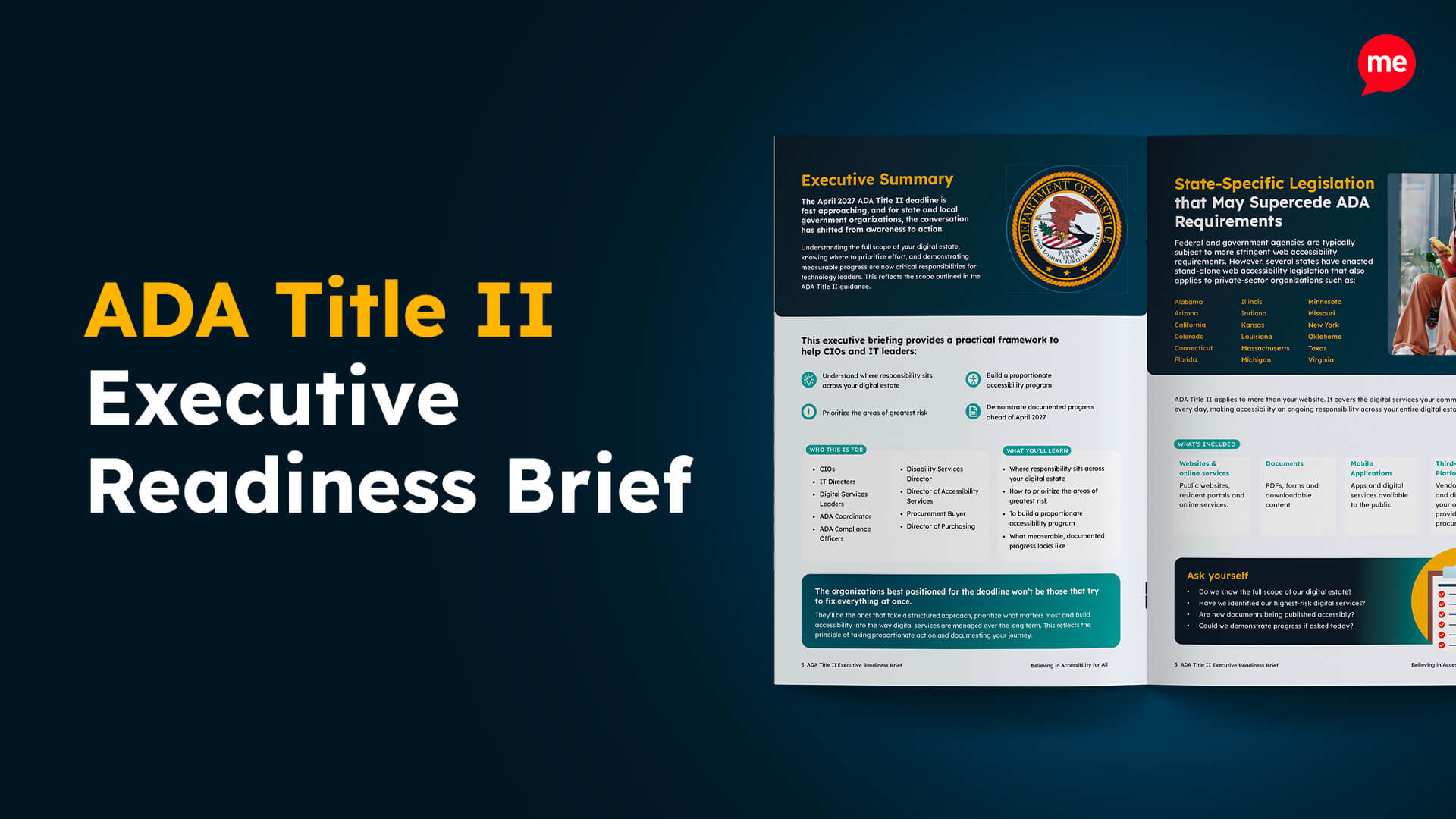
Title II applies to cities, counties, public schools, and public universities. The DOJ has issued a formal web accessibility rule under Title II, clarifying that government websites, mobile apps, and digital services must meet defined accessibility standards. Deadlines are set for April 2027 (larger entities with populations of 50,000+) and April 2028 (smaller entities with populations of less than 50,000).


Title III: Public accommodations
Title III applies to all private-sector businesses that provide goods or services to the public, regardless of employee count. This includes:
- Retail stores and restaurants
- Hotels and entertainment venues
- Health care providers
- Educational institutions
- E-commerce websites and online service providers
For most California businesses, this is the most relevant provision.
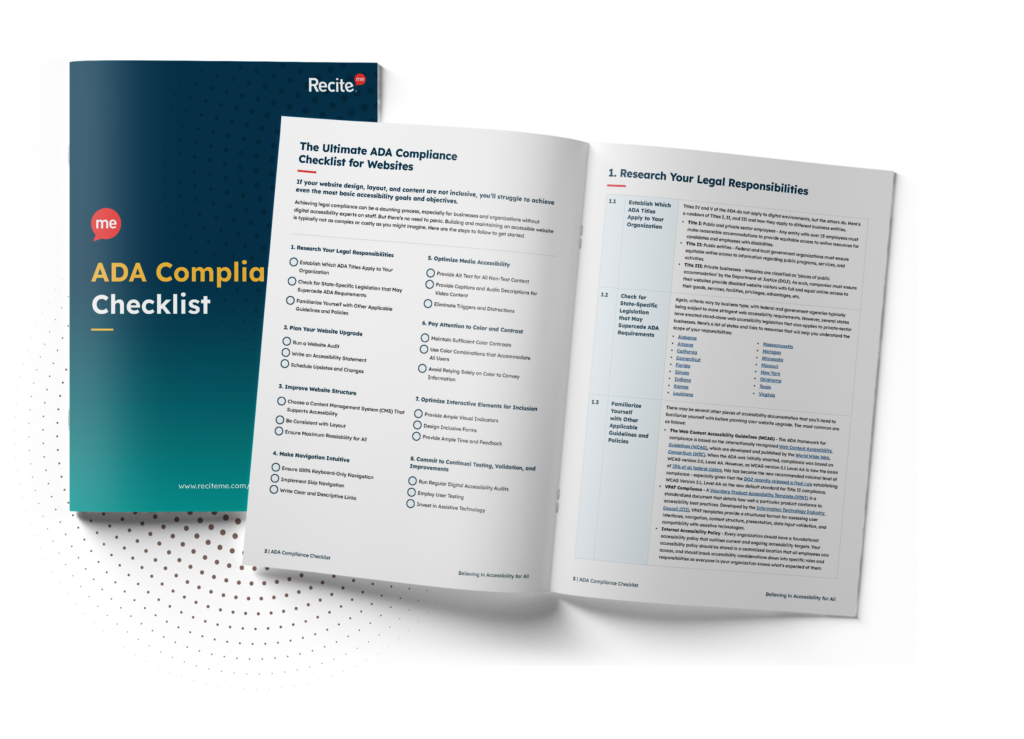
Want to make sure your website is compliant with the Americans with Disabilities Act? Then unlock the ADA compliance checklist now. Discover actionable steps to ensure ADA compliance, helping you avoid lawsuits and any other negative consequences of non-compliance.
Which technologies are covered by ADA in California?
Digital accessibility obligations are not limited to your company’s main website. They extend to the full range of online tools and platforms used to deliver services to the public. This typically includes:

- Websites and key templates (home pages, service pages, checkout flows, lead forms)
- Mobile apps
- Online portals (payments, bookings, admissions, patient portals)
- PDFs and downloadable documents
- Video and multimedia content (captions, transcripts, and audio description where required)
- Third-party tools embedded into your site, such as chat widgets, scheduling systems, and payment processors
In short, if a digital tool is used to provide information, complete transactions, or access services, it must be accessible.
Best practices to become ADA web compliant in California
Many organizations assume accessibility is a one-time task. In reality, compliance requires ongoing monitoring and structured improvement.
Regular accessibility tests
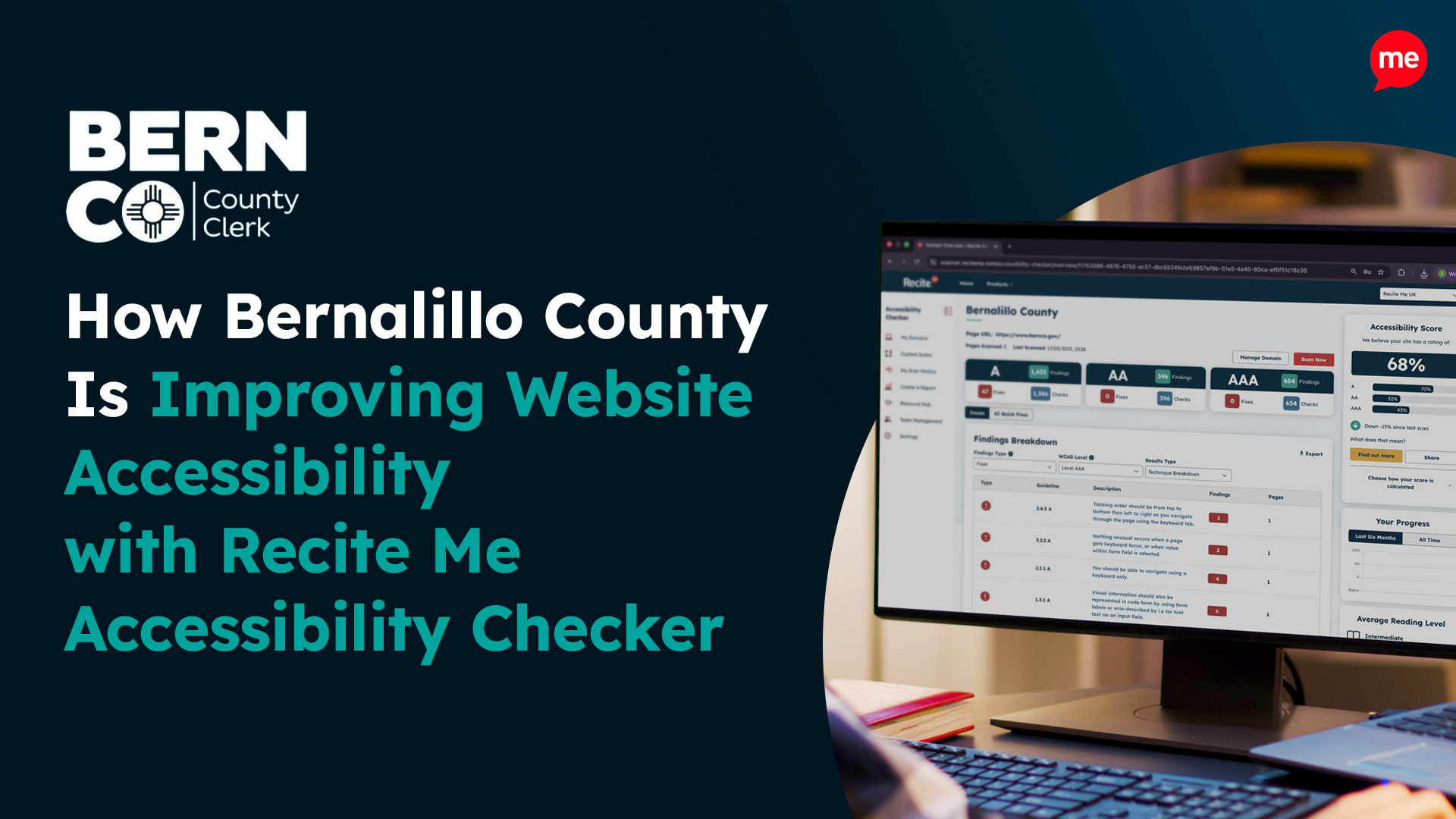
Automated tools like the Recite Me Accessibility Checker can quickly identify common issues and help prioritize remediation efforts within a structured roadmap. However, automated scans alone are often not sufficient for ADA compliance in California.

A defensible accessibility approach typically combines:
- Automated accessibility testing to detect issues like missing alt text, color contrast failures, and structural errors.
- Thorough manual reviews to assess keyboard navigation, focus order, form functionality, and other issues that automated tools may miss.
- Real-user testing with assistive technologies such as screen readers or voice navigation tools to identify practical usability barriers in real-world scenarios.
Testing should be conducted regularly, particularly after design updates, new feature releases, or major content uploads. Ongoing monitoring demonstrates documented good-faith compliance efforts and reduces the likelihood of preventable violations.
Meeting WCAG requirements
While the ADA does not include a detailed technical checklist within the statute itself, courts and regulators consistently reference the Web Content Accessibility Guidelines (WCAG) as the benchmark standard for digital accessibility.
WCAG is built around four core principles. Content must be:
- Perceivable: Information and user interface components must be presented in ways users can recognize, including alternatives for images and sufficient color contrast.
- Operable: Users must be able to navigate and interact with content, including full keyboard accessibility and logical focus order.
- Understandable: Content and functionality must be clear and predictable, with readable text and helpful form instructions or error messages.
- Robust: Content must work reliably with assistive technologies such as screen readers and remain compatible as technologies evolve.

For California public entities governed by Title II, the DOJ’s updated rule formally requires compliance with WCAG 2.1 Level AA by the applicable deadlines. However, it is strongly recommended that all organizations, whether public or private, align with WCAG 2.2 Level AA to future-proof their compliance efforts.
Risks of not complying with ADA guidelines in California
To fail to comply with ADA guidelines is to fail to make your website, or business for that matter, accessible. Not only can this lead to an onslaught of costly litigation, but can also trigger a series of negative consequences for your business and its long-term growth. For businesses in California, it’s essential to understand these potential consequences if you are to avoid serious setbacks. In this section, we’ll explore the risks of ADA non-compliance in detail.
Legal Penalties
Failing to meet the requirements can lead to costly ADA lawsuits. Businesses that are found in violation of ADA accessibility standards can face substantial fines, sometimes as high as $75,000 for a first violation, with subsequent violations potentially costing up to $150,000 per instance. On top of that, legal fees can add up quickly, leaving your business financially vulnerable on multiple fronts.
Lost Market Opportunities
By disregarding accessibility, you are turning your back not only on your existing disabled customers, but the disabled community as a whole. By failing to accommodate these individuals, businesses miss out on a vast pool of potential customers, declining a huge opportunity to grow their sales.

Reputational Damage
ADA digital accessibility lawsuits are on the rise. In 2023, there were a total of 4,605 cases reported, marking a 14% rise from 2022. A lawsuit or public accusation of discrimination can significantly damage a brand’s reputation. Even if the lawsuit is not successful, the very fact you were involved in such a case can tarnish the public’s perception of your business for years to come.
Consumers are increasingly aware of accessibility issues, and businesses that neglect ADA compliance may face backlash from both the disabled community and the general public. In a time when online reviews and social media can make or break a company’s image, poor accessibility is a risk not worth taking.
Operational Setbacks
Addressing ADA compliance after launching a website or product can be more costly and time-consuming than doing so from the outset. Retrofitting a website to meet accessibility standards requires additional development, which can disrupt operations and lead to increased project timelines.
In some cases, businesses may need to completely overhaul certain digital assets, resulting in significant expenses and delays. Adopting a proactive approach to accessibility through a policy of ‘test and improve’ is not always possible, but is always preferred. It means that even if you’ve already launched your website, you can plan adjustments for the future according to your own project pipeline, rather than reacting frantically to a lawsuit settlement.
Examples of real ADA lawsuits in California
California has seen several high-profile ADA lawsuits, which underscores the importance of compliance. This section summarizes three noteworthy cases.

National Federation of the Blind v. Target Corporation
This landmark case established that websites associated with physical retail locations may be subject to ADA requirements. Target agreed to a $6 million settlement and committed to making its website accessible to screen reader users. The case reinforced that inaccessible digital platforms can trigger federal disability discrimination claims.
Robles v Domino’s Pizza LLC
In the case of Robles v Domino’s, Mr. Robles, a blind customer, sued Domino’s Pizza for having an inaccessible website and mobile app, as he was unable to order food due to the site not being compatible with his screen reader. The Ninth Circuit Court ruled in favor of Robles, stating that Domino’s was in violation of California’s Unruh Civil Rights Act. The court ordered Domino’s to make its website accessible according to WCAG 2.0 guidelines as a result.
Californians for Disability Rights v. Mervyn’s LLC
The Californians for Disability Rights v. Mervyn’s LLC case of 2002 involved a group of plaintiffs who filed a class-action lawsuit against the retail chain, Mervyn’s. The plaintiffs alleged that physical barriers at store locations, such as inadequate aisle space, violated the ADA. As a result, the retail chain agreed to make substantial modifications to its facilities, setting a precedent for ADA enforcement in California.
Free ADA Compliance Audit of your Website
Run a free scan of your website's homepage to identify any ADA violations. Then, use our recommendations to implement fixes and achieve ADA compliance.
Check Your Website for ADA Compliance Today
For most businesses and public entities, the steps to follow are the same:
- Identify which ADA title applies to your organization
- Audit your digital assets against WCAG standards
- Prioritize high-impact barriers
- Establish ongoing monitoring and governance
Not sure where to begin? Request your free ADA compliance check today and speak with our team for practical guidance tailored to the California laws and compliance requirements that apply to your organization.
ADA compliance in California FAQs
Looking for a recap or quick summary? Here are a few of our most frequently asked questions to help you get to grips with the essentials:
Does California have its own accessibility law in addition to the ADA?
Yes. While the ADA is a federal law, California’s Unruh Civil Rights Act allows accessibility claims to include statutory damages in addition to federal remedies. This increases potential financial exposure compared to many other states.
Does making my website ADA-compliant protect me from Unruh Act claims?
Not entirely. However, aligning your website with WCAG standards can help demonstrate good-faith compliance and reduce your exposure to Unruh Act claims if an individual alleges they were denied equal access.
Does complying with the Unruh Civil Rights Act protect me from ADA claims?
Again, no. The ADA and the Unruh Act are separate laws. Aligning your website with WCAG standards helps reduce risk under both, but meeting the requirements for one law does not replace the need to ensure compliance with the other.
Is WCAG 2.2 required in California?
For public entities governed by Title II, the DOJ’s rule requires compliance with WCAG 2.1 Level AA. WCAG 2.2 is not currently mandated but may be adopted voluntarily as a best-practice standard.
Can small businesses in California be sued for website accessibility issues?
Yes. Title III applies to businesses that provide goods or services to the public, regardless of employee count. California’s legal framework can increase exposure when accessibility barriers prevent equal access.
Do third-party tools affect ADA compliance?
Yes. Businesses remain responsible for the accessibility of third-party tools embedded on their websites, including payment processors, booking systems, chat widgets, and other service integrations.
Need more help becoming ADA compliant?
The following resources are packed full of actionable tips and expert advice for making your digital content compliant with the Americans with Disabilities Act:
Free ADA Accessibility Training
Take the first step to ADA compliance by completing our training course.
Free ADA Accessibility Guide
Ensure your organization is meeting the requirements for ADA compliance.