

Free ADA Compliance Audit of your Website
Run a free scan of your website's homepage to identify any ADA violations. Then, use our recommendations to implement fixes and achieve ADA compliance.
San Francisco is a city widely recognized as a leader in many sectors, most notably tech. It is also known for its progressive and inclusive values. This means that ADA compliance is an essential consideration for every business located in San Francisco, and not just because it is a federal requirement. ADA compliance is also vital for ensuring equal access and developing a positive brand reputation in a competitive marketplace.
In this guide, we cover everything you need to know about achieving ADA compliance in San Francisco, including who the act applies to, strategies for compliance, and plenty more.

The basics of the Americans with Disabilities Act
So, what exactly is ADA? This is an acronym for the Americans with Disabilities Act, which is a federal civil rights law that prohibits discrimination against people with disabilities. Implemented in 1990, ADA was established to ensure that individuals with disabilities have the same opportunities and rights as everyone else. This applies to many areas of life, including employment, purchasing goods and services, and participating in government programs.
Which organizations in San Francisco need to comply with the ADA?
As a federal civil rights law, the ADA applies to employers, state and local governments, businesses open to the public, commercial facilities, transport providers, telecommunication providers, and more.
That said, there are often significant differences in the ADA requirements for public entities and private businesses. Let’s take a look:
State and local governments
Public entities, including all state and local governments, should ensure that programs, activities, and services are accessible. This includes:
- Public education
- Transportation
- Healthcare
- Recreation
- Social services
- Courts
- Voting
- Emergency services
- Town meetings
Private businesses
For businesses with 15+ employees, steps must be taken to ensure that individuals with disabilities have an equal opportunity to benefit from all employment-related opportunities that are available to others. This includes:
- Recruitment
- Onboarding
- Promotions
- Training
- Pay
- Social activities
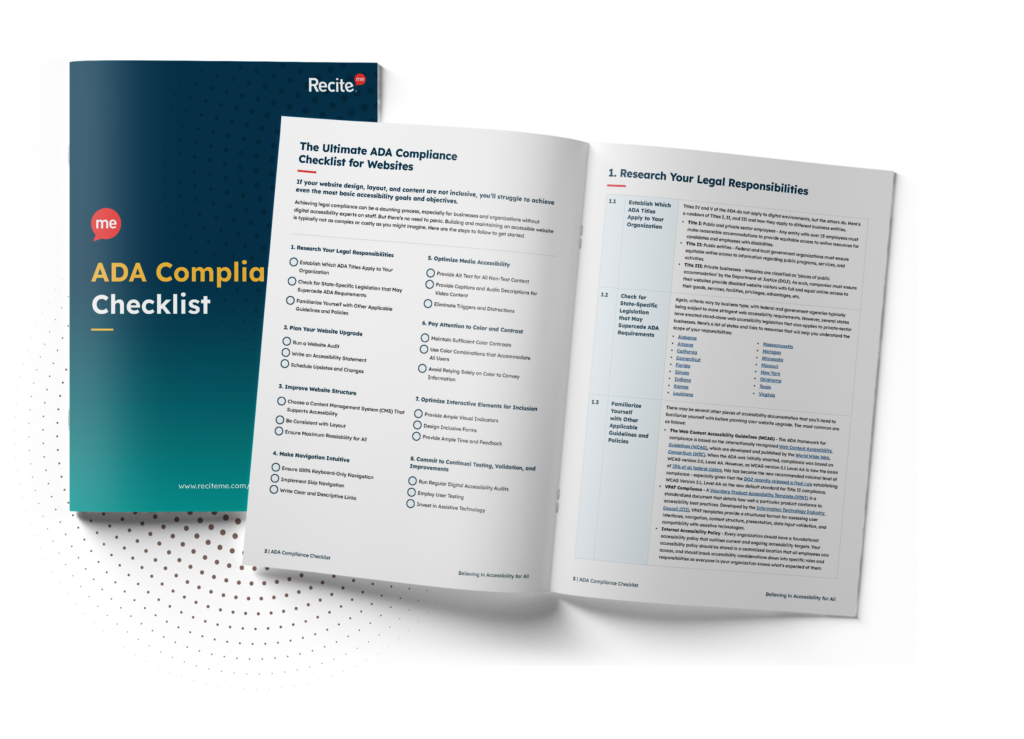
Want to make sure your website is compliant with the Americans with Disabilities Act? Then unlock the ADA compliance checklist now. Discover actionable steps to ensure ADA compliance, helping you avoid lawsuits and any other negative consequences of non-compliance.
Physical adjustments your business may be required to make
It is often required that businesses in San Francisco make a few physical adjustments to ensure buildings and facilities are accessible. This can include the use of ramps and lifts for wheelchair users and making sure that restrooms meet accessibility standards. These adjustments ensure that the business is accessible for employees, customers, and any other visitors to the premises.

The specific requirements your business needs to make will depend on various factors, including the location, size, layout, and age of the space. It is generally required that barriers must be removed where “readily achievable”, which means large, structural changes are often avoidable.
Digital adjustments San Francisco companies must make
With many San Francisco businesses offering digital services, there are specific digital adjustments often required to ensure accessibility for users with a range of disabilities.
Organizations should use WCAG 2.1 Level AA as a benchmark. WCAG 2.1 Level AA includes over 50 success criteria for digital content that meets the POUR Principles (Perceivable, Operable, Understandable, Robust). Examples include:
- Descriptive alt text for images
- Captions provided for all prerecorded audio content
- Color contrast between the background and text
- Content does not restrict the view to portrait or landscape

Steps to take towards ADA compliance in San Francisco
To achieve ADA compliance, businesses located in San Francisco must take a few key steps:
Conduct an ADA compliance audit of your website
A smart place to start is with an ADA compliance audit of your website. This will highlight any non-compliance issues so that immediate fixes can be found.

An ADA compliance audit does not have to be a time-consuming, laborious task thanks to tools such as the Recite Me Web Accessibility Checker. This tool can quickly scan your website and detect any specific areas that are non-compliant, such as navigation issues or missing alt text. Guidance is also provided on how you can fix these issues, helping you quickly create an ADA-compliant and easy-to-use website.
For businesses that regularly publish new content and/or launch new features, it is wise to conduct regular audits to ensure ongoing compliance.
Implement web accessibility fixes in line with WCAG
When it comes to fixing issues with your website and online content, WCAG should be used to guide your decisions. Specifically, this means compliance with WCAG 2.1 Level AA requirements. When fixes are made in line with WCAG, San Francisco businesses can feel confident knowing that the website meets recognized accessibility standards.
Some of the most common WCAG fixes you can implement for ADA compliance include:
- Improving color contrast between text and backgrounds
- Adding/improving alt text to images
- Making website navigation easier
- Ensuring all interactive elements can be accessed with a keyboard
Train your teams on ADA accessibility best practices
It is also important to note that ADA compliance requires your teams to be aware of ADA accessibility best practices. In particular, this includes any teams involved in the development and maintenance of digital assets. This can include developers, designers, content creators, and marketers.

Training employees on ADA accessibility best practices ensures that digital assets are built to be accessible by all users and WCAG-friendly, helping to avoid fixes down the line as well as legal issues and a damaged reputation. Recite Me offers training resources that can help San Francisco businesses make ADA website compliance training an integral part of everyday workflows.
Why ADA compliance is so important for San Francisco businesses
ADA compliance should be a top priority for businesses in San Francisco for a few key reasons that can significantly impact the organization.
Avoid financial penalties for non-compliance
There are significant financial repercussions to be aware of. Failure to comply with Title III of the ADA can incur federal fines, with maximum fines for first violations between $55,000 and $75,000. Subsequent violations can reach $150,000. There are also other legal costs to factor in, including legal fees, settlements, and remediation efforts.


Missed revenue opportunities
Non-compliance can also lead to significant missed revenue opportunities that can hold your business back from higher levels of success. CDC data shows that over 70 million US adults report having a disability, which equates to around 1 in 4 people. This means businesses risk excluding a significant portion of the population if there are physical or digital barriers in place.
Tougher regulatory scrutiny
The State of California is known to be proactive when it comes to disability rights. This means that businesses in the San Francisco area should expect tougher regulatory scrutiny in the form of investigations, formal complaints, and legal notices. It is important to show evidence of regular audits, accessibility policies, and remediation efforts.


Damage to your perceived brand image
In a city known to be progressive and inclusive, failure to make your business accessible can lead to a damaged brand image. This can lead to complaints, negative social media comments, and harmful publicity that can be hard to recover from. On the other side, companies that clearly demonstrate a commitment to accessibility can benefit from a positive reputation that can make it easier to build trust with their target audience and stand out from the crowd.
Free ADA Compliance Audit of your Website
Run a free scan of your website's homepage to identify any ADA violations. Then, use our recommendations to implement fixes and achieve ADA compliance.
Build an accessible online business in San Francisco today
The importance of ADA compliance in San Francisco cannot be overstated. In addition to being a legal requirement with non-compliance penalties, ADA compliance ensures that your business is accessible to all. In a city that is known for inclusivity and social responsibility, accessibility can help brands develop a positive brand image and stand out from the crowd.
To get started on your compliance journey, we recommend running a free ADA audit of your website. You can also reach out to a member of our team to see how we can help your organization become ADA-compliant.
ADA Compliance in San Francisco FAQs
Looking for a recap or quick summary? Here are a few of our most frequently asked questions to help you get to grips with the essentials:
Are businesses of fewer than 15 employees exempt from the ADA?
No, Title I employment provisions apply to businesses of 15+ employees, but businesses of all sizes must comply with Title III requirements for public accommodations. If your business serves the public, physical and digital accessibility is expected.
How can a business demonstrate ADA compliance efforts?
Organizations can demonstrate ongoing compliance efforts with a strong paper trail. This should include documentation of accessibility audits, remediation efforts, and employee training. This will reduce legal risk and simplify any investigations.
Do older buildings need to be adapted for ADA compliance?
Buildings do not always need to be adapted for ADA compliance, but efforts must be made to remove barriers where “readily achievable”. This can include steps like installing ramps and lowering service desks as opposed to large, structural changes to the building.
Are there any ADA compliance tax incentives for businesses?
Yes, two tax incentives are available for businesses to help cover the costs involved in ADA compliance. There is a tax credit that is available for small businesses and a tax deduction for all businesses. Employers may also receive tax credits for hiring certain people with disabilities, such as veterans with service-related disabilities.
Need more help becoming ADA compliant?
The following resources are packed full of actionable tips and expert advice for making your digital content compliant with the Americans with Disabilities Act:
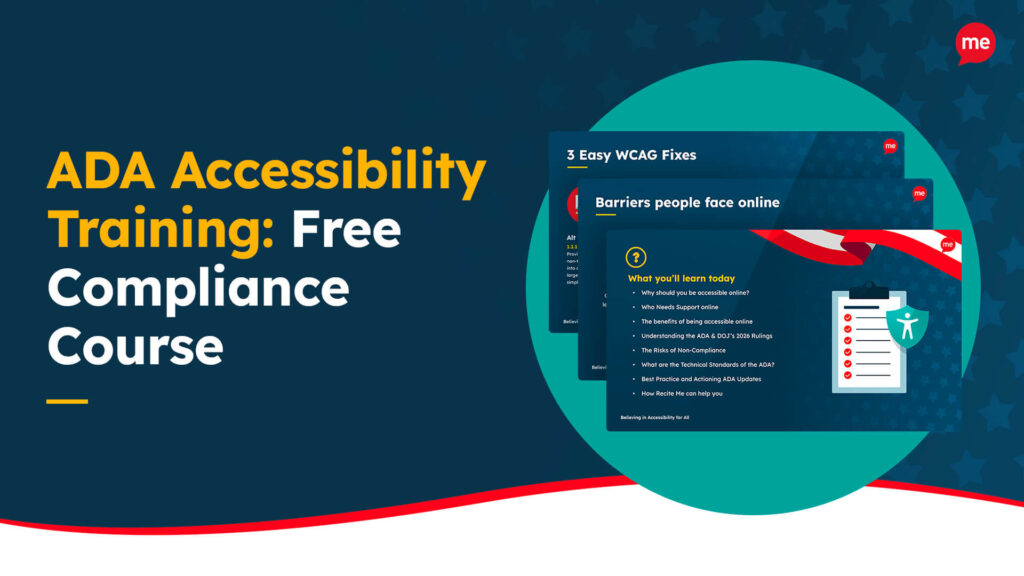
Free ADA Accessibility Training
Take the first step to ADA compliance by completing our training course.
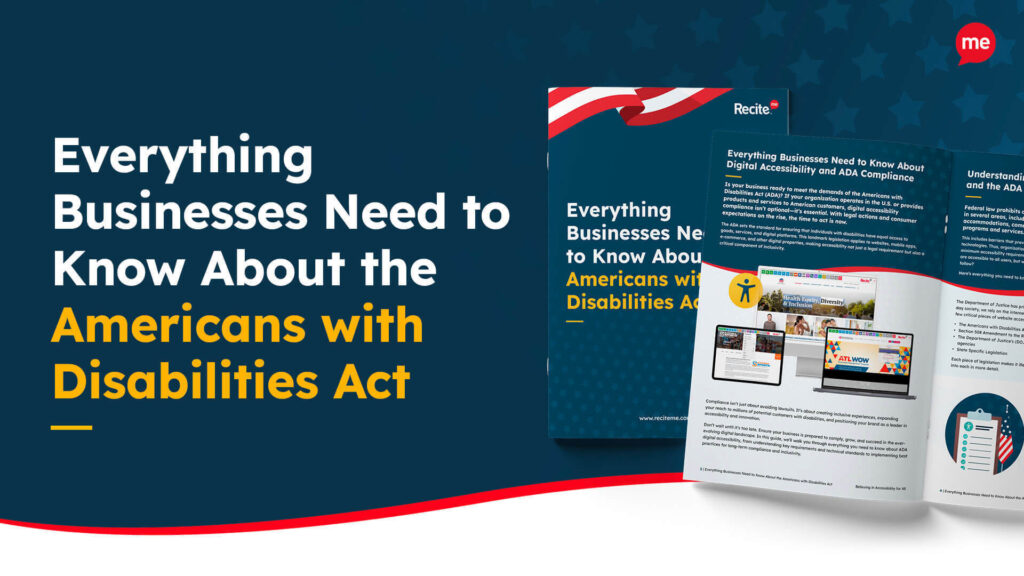
Free ADA Accessibility Guide
Ensure your organization is meeting the requirements for ADA compliance.