Virginia has taken a major step forward in digital inclusion. HB 2541, the update to the Commonwealth’s Virginia Information Technology Access Act, introduces a modern and accountability-driven model that places digital accessibility at the heart of public-sector procurement.
Under HB 2541, accessibility is no longer a “best practice” or an optional consideration. It becomes a core requirement that must be embedded into how public bodies purchase websites, software, applications, digital platforms, and cloud-based ICT solutions.
If you are a Virginia public-sector organization– or a vendor selling into the Commonwealth –this legislation directly affects how you operate, procure, and deliver digital services.
Below, we break down what HB 2541 changes, who it covers, and what you should do now to prepare.
What HB 2541 Achieves
HB 2541 modernizes Virginia’s accessibility requirements in four major ways:
1. Expands Who Must Be Served
Historically, the Act focused primarily on individuals who were blind or visually impaired. HB 2541 recognizes today’s broader definition of disability and the need for inclusive digital access for all Virginians, including people with:
Cognitive or learning disabilities
Mobility and dexterity impairments
Low vision
Neurodiverse needs
Language and literacy barriers
This sets a more inclusive and equitable standard across the Commonwealth.
2. Broadens What Qualifies as ICT
The updated law now explicitly covers websites, digital platforms, software, mobile apps, cloud tools, online services, and communications technologies.
This sets a more inclusive and equitable standard across the Commonwealth.
3. Introduces a Procurement-Based Accountability Model
This is the most transformational part of HB 2541. Public bodies must now require vendors to provide:
A current Accessibility Conformance Report (ACR) using the VPAT format
Transparent disclosure of accessibility gaps
A time-bound remediation plan outlining how and when those gaps will be closed
This shifts responsibility upstream, making vendors accountable for accessibility from day one, rather than placing the burden on public bodies after procurement.
4. Phases Compliance Based on Entity Size
To ensure a realistic transition, the law introduces a staggered timeline:
Large entities move first
Smaller organizations follow
This provides time for training, contract updates, vendor engagement, and digital modernization.
Who Is Covered by HB 2541?
The legislation applies broadly across the Commonwealth. Covered entities include:
State agencies and state public bodies
Public institutions of higher education
Public school divisions
Local governments, counties, cities, and special districts
If you are anywhere within the Virginia public-sector ecosystem or if you are a vendor providing ICT into that ecosystem, HB 2541 applies to you.
Key Requirements for Compliance
The expectations under HB 2541 are clear and transparent.
1. All New or Renewed ICT Contracts Must Include Accessibility Requirements
Accessibility must be integrated into:
RFPs
Vendor agreements
Renewals
Procurement templates and approval processes
2. Vendors Must Provide Current VPAT/ACR Documentation
Documentation must be:
Up to date
Honest about gaps
Accompanied by a credible remediation roadmap
Mapped to WCAG 2.1 or 2.2 AA, the referenced standards
3. Entities Should Appoint a Digital Accessibility Coordinator
This ensures internal accountability and creates a central point of governance, training, and remediation oversight.
4. Exceptions Exist, But Are Narrow
Limited exemptions apply only if:
The accessible equivalent increases cost by more than 5%, or
The ICT is strictly used by individuals without disabilities
These limitations reinforce that accessibility must be the default, not an afterthought.
Deadlines and Phasing
HB 2541 includes a phased rollout aligned with entity size:
April 26, 2027
Applies to:
Entities serving 50,000+ residents
All state public bodies
All public institutions of higher education
April 26, 2028
Applies to:
Smaller localities (serving under 50,000 residents)
Special districts
This ensures all public bodies reach the same standard, with time to adjust internal processes and contracts.
Free ADA Compliance Audit of your Website
Run a free scan of your website's homepage to identify any ADA violations. Then, use our recommendations to implement fixes and achieve ADA compliance.
Why HB 2541 Matters
This legislation solves a longstanding issue: public entities often purchase inaccessible software or websites, only to discover the problems later – leading to costly remediation, barriers for residents, or exposure to legal risk.
HB 2541 delivers:
Reduced legal exposure
Stronger procurement governance
More predictable vendor accountability
Modernized, inclusive digital experiences for every Virginian
A competitive advantage for vendors who take accessibility seriously
It creates a more transparent, equitable, and user-centered digital landscape across the Commonwealth.
How Recite Me Supports HB 2541 Compliance
Recite Me helps public-sector organizations and vendors meet both the spirit and letter of HB 2541.
This directly supports VPAT/ACR preparation and ongoing compliance.
2. Usability & Inclusion: Assistive Toolbar
Beyond compliance, the Assistive Toolbarhelps residents access and use content by providing:
Screen reading
Translation into 100+ languages
Adjustable text size, fonts, spacing, and contrast
Reading guides, focus tools, and content simplification
This supports users with disabilities, aging populations, multilingual communities, and individuals with literacy challenges.
3. Governance, Communication & Transparency
Recite Me helps organizations:
Publish accessibility statements
Build remediation roadmaps
Communicate progress
Prepare vendor documentation for procurement
This aligns directly with HB 2541’s vendor accountability model.
A Turning Point for Digital Inclusion in Virginia
HB 2541 marks a cultural and operational shift. Accessibility is now a fundamental requirement of responsible public service, not a checkbox or afterthought.
For organizations in Virginia, the time to modernize is now. And Recite Me is here to support every step from assessment and compliance to inclusive user experience and procurement-ready documentation.
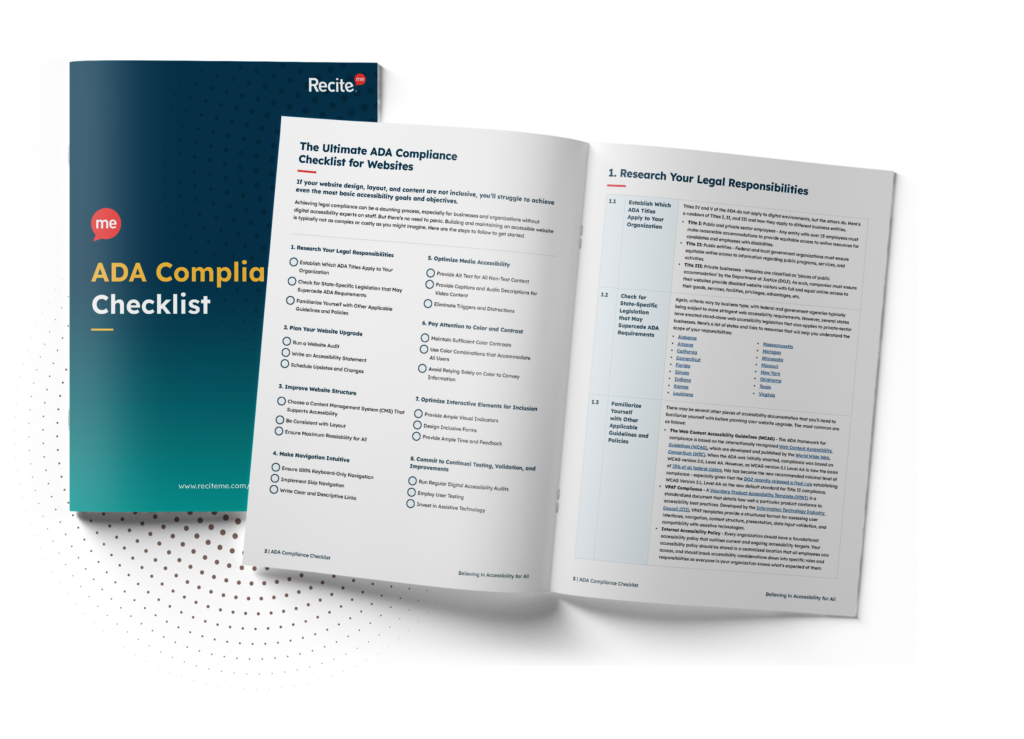
Download your free ADA Compliance Checklist
Want to make sure your website is compliant with the Americans with Disabilities Act? Then unlock the ADA compliance checklist now. Discover actionable steps to ensure ADA compliance, helping you avoid lawsuits and any other negative consequences of non-compliance.
Discover how one public sector organization responded after an accessibility audit uncovered 500+ inaccessible PDFs, turning a major remediation challenge into a clear action plan....
To mark Dyslexia Awareness Month, we caught up with Nelms Foundation to discuss the myths that persist around dyslexia and why inclusive digital experiences matter...
In the United States, the Department of Justice's ADA Title II rule has given public entities clearer expectations for the accessibility of their websites and...