

Free ADA Compliance Audit of your Website
Run a free scan of your website's homepage to identify any ADA violations. Then, use our recommendations to implement fixes and achieve ADA compliance.
On 20 April 2026, the Department of Justice published its final rule extending the compliance dates for ADA Title II digital accessibility obligations. If your organization is a state or local government entity in the United States, this news directly affects your timeline.
An extra year is a genuine opportunity to do this work properly. The question is what you do with it? We have to remember that the longer we take to take action on accessibility, the longer we negatively impact people with disabilities needing to access vital information.
What the DOJ changed with its new ADA compliance deadlines
Here are the updated compliance dates, as published by the DOJ:
| Larger entities (population 50,000+) | New deadline: 26 April 2027 (extended from 24 April 2026) |
| Smaller entities & special districts | New deadline: 26 April 2028 (extended from 26 April 2027) |
| Accessibility standard | WCAG 2.1 AA — unchanged |
| The legal obligation | ADA Title II — unchanged |
For most larger public entities, states, cities, counties, school districts, transit authorities, public universities that means you now have until April 2027. For smaller entities and special district governments, April 2028.
What the ADA extension does not change for public sector organizations
Regardless of the compliance dates, covered entities have an ongoing obligation to ensure that their digital services, programs, and activities offered are accessible to individuals with disabilities under Title II of the ADA. This is an obligation that has existed for decades, and it’s as important today as it’s ever been.

The technical standard itself is also unchanged. Covered entities must still meet WCAG 2.1 Levels A and AA, which includes distinct success criteria covering key accessibility features, such as keyboard navigation, alternative text for non-text content, captions for audio, color contrast, and more.
Covered entities that fail to comply with the new deadline risk DOJ enforcement actions, administrative complaints, private lawsuits by individuals with disabilities, and even loss of public funding.
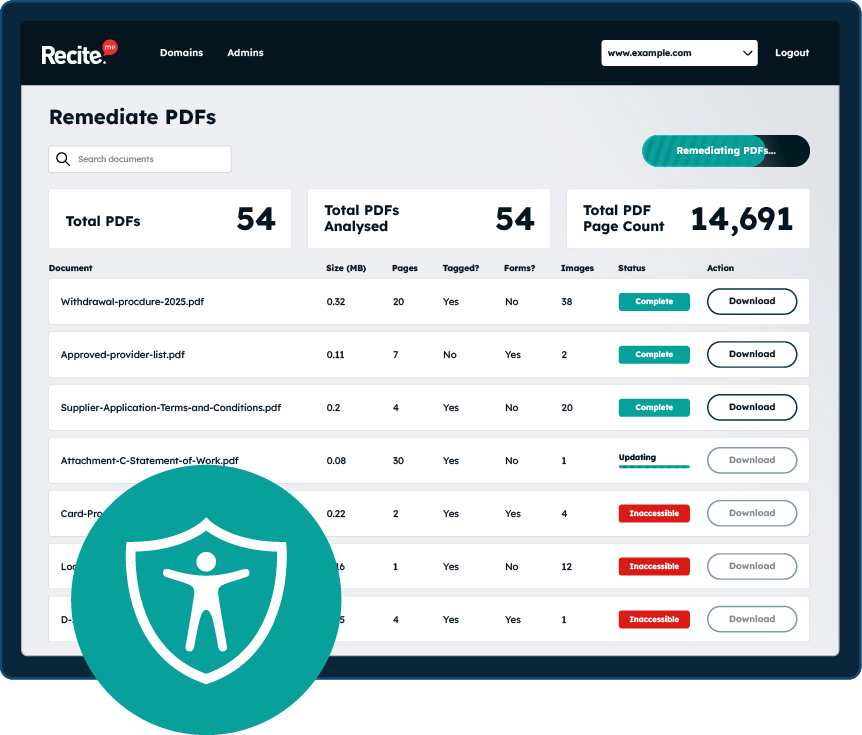
Scan your website to locate every PDF in one place and instantly see how many do not meet accessibility standards. You will also receive one of your website’s PDFs fully remediated, so you can see the impact in action.
Why has the DOJ extended the deadlines for ADA compliance
The DOJ extended the deadlines because digital accessibility across a public sector estate is genuinely complex work. It takes time to audit websites, remediate issues, fix document libraries, update publishing processes, train teams, and build the governance to maintain accessibility over time.

That acknowledgement matters, as it shows you how regulators are thinking about this. They are not expecting perfection overnight. Instead, they want to see proportionate action that is structured and documented throughout. By extending the deadline, the DOJ has ensured public sector organizations now have time to prepare for full compliance.
What this means in practice for US public sector organizations
If you’re a state or local government entity working through your ADA Title II obligations, the extended deadline changes your timeline. It does not change what accessibility looks like. Here is what a structured compliance plan should look like:
1. Visibility across your full digital estate
You cannot fix what you cannot see. That means understanding what websites and web pages you have, what documents are published and publicly accessible, and where the accessibility failures are.
However, for most public entities, the website is only part of the picture. PDFs, guidance documents, planning reports, policies, and more are also frequently overlooked accessibility risks that public sector organizations must consider.

2. Structured, prioritized action
Once you have visibility, the work becomes about priority and process. Start with high-traffic pages, essential services, public-facing forms, and documents that residents rely on for decisions. Legacy archive content and low-traffic pages can be remediated at a later date.
The point is not to fix everything at once. The point is to have a plan, work the plan, and evidence the steps taken.
3. A documented record of your accessibility journey
A clear, honest record of what you’ve scanned, what issues you’ve found, what you’ve fixed, and what you’re working on next is what separates organizations that are managing their obligations from those that are hoping nobody notices.
This record should include:
- Regular accessibility scanning, run consistently, not just once
- Evidence of the actions you’ve taken and the improvements you’ve made
- An accessibility statement that honestly reflects where you are and what you’re doing about it
- Accountability for ongoing improvements over time
This documentation is what you can stand behind if a complaint arrives, a procurement officer asks, or if a federal audit commences. The organizations without it are exposed, while the ones with it are protected.
Actions your organization should take now
Whether you’ve already started your Title II work or you’re still at the beginning, here is how to use the extended timeline well.

If you’ve already started
Don’t let a new deadline become a reason to slow down. Every month of structured progress between now and April 2027 builds the record that protects you. Accelerate where you can and expand scope into your document estate if you haven’t already.
If you haven’t started
Now is the time to act if you haven’t already. Start with an accessibility scan of your website and your PDFs for visibility. Once you understand the scale of the challenge, you can build a plan that is honest about what you can achieve and in what order, then work at it consistently.

If you’re somewhere in between
If you’ve started the journey towards ADA Title II compliance, but aren’t quite there yet, now is the time to assess where the gaps are.
Most public entities have worked on website accessibility, but have not yet addressed their document estate. PDFs are consistently the largest remaining accessibility risk for organizations that have otherwise made progress. If that sounds familiar, the PDF estate is where to focus next.
How Recite Me helps public sector organizations comply with ADA requirements
Recite Me works with public sector organizations to build structured, documented accessibility programmes.
This means that you can expect:
Automated scanning of your website to identify accessibility failures against WCAG 2.1 AA, giving you visibility across your estate and a prioritized picture of what to address first
PDF Accessibility Checker and Remediation, automated crawling of your entire PDF estate to identify inaccessible documents, with AI-driven remediation at scale, so you can address your document library without a slow and expensive manual process
Ongoing monitoring, so that as your website and documents change over time, your accessibility position is maintained, not just fixed once and forgotten
The documentation to show a clear record of what has been scanned, what has been found, what has been fixed, and the progress you’re making over time
We work with state and local government entities across the United States, helping them achieve ADA compliance. The extension gives you more time to address accessibility issues across your digital landscape, and we’re here to help you work toward full compliance.
Free ADA Compliance Audit of your Website
Run a free scan of your website's homepage to identify any ADA violations. Then, use our recommendations to implement fixes and achieve ADA compliance.
Final take on the adjusted ADA compliance deadlines
The deadline moved, but the underlying obligation to make digital content and services accessible under Title II did not. For larger public entities, the new compliance date is April 26, 2027. For smaller entities and all special district governments, it is April 26, 2028. This additional time should be used wisely to build a sustainable accessibility program from today.
You can contact us today for more information on how Recite Me can support your organization toward ADA compliance.
New ADA Compliance Deadlines FAQs
Looking for a recap or quick summary? Here are a few of our most frequently asked questions to help you get to grips with the essentials:
What has changed with the ADA Title II digital accessibility deadlines?
The US Department of Justice has extended the compliance deadlines for digital accessibility under ADA Title II:
- Larger public entities (population above 50,000): now due by 26 April 2027
- Smaller public entities (population below 50,000): now due by 26 April 2028
Does the ADA extension change accessibility obligations right now?
No, public sector organizations still have an ongoing responsibility to ensure digital content and services are accessible. The extension affects the enforcement timeline, not the expectation to provide accessible access today.
Who does ADA Title II apply to?
ADA Title II applies to US state and local government entities, including cities, counties, public universities, schools, transit authorities, and special district organizations.
What risks exist if organizations do not meet the new ADA deadline?
Organizations may face enforcement action, complaints, legal challenges, and potential funding risks if they do not meet compliance deadlines or demonstrate meaningful progress toward accessibility.
Need more help becoming ADA compliant?
The following resources are packed full of actionable tips and expert advice for making your digital content compliant with the Americans with Disabilities Act:
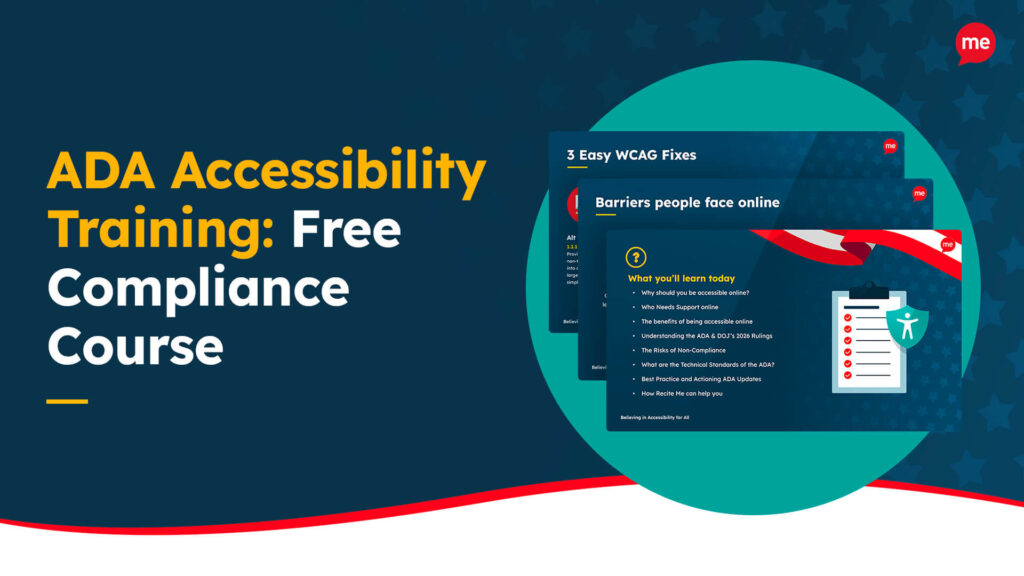
Free ADA Accessibility Training
Take the first step to ADA compliance by completing our training course.
Free ADA Accessibility Guide
Ensure your organization is meeting the requirements for ADA compliance.